
The question we got again this week
Three times a week, someone asks us. In first meetings with new clients, in university talks, at events alongside other architects: "Pablo, won't AI leave architects out of work?". The short answer is no. The long answer is what we're writing today, and it's more interesting because it starts by explaining that the question is poorly framed.
This is not unfounded paranoia. There is data. The American Institute of Architects (AIA) published a 2024 study where 90% of professionals report concern about the accuracy, unintended consequences and transparency of AI-generated outputs¹. That same report describes roles "between the creative process and production" as the most exposed to automation². It's not science fiction: there are real tasks the machine already does better or faster.
Here's the catch: confusing task automation with trade replacement is the kind of mistake that produces bad predictions.
What the people actually using it say
Patrik Schumacher, principal at Zaha Hadid Architects (one of the most influential studios in the world), wrote a sharp piece in Dezeen in 2023: **"I am not at all worried about facing the newly empowered competition enabled by AI"**³. Not because he underestimates it, but because he understands how it works. ZHA already uses Midjourney and DALL·E across most of its projects, especially in competitions and early ideation. The most honest line about their real process:
We take between 10 and 15 percent of the output from AI image generators forward to 3D modeling.
Ten percent. The rest is discarded. AI generates a lot of material, and the skill that matters is still knowing what to discard and what to develop. That skill is not automatable. That skill is called architectural judgment.
Bjarke Ingels, founder of BIG, was more poetic at the 2025 Venice Biennale. His installation Ancient Future showed Bhutanese artisans hand-carving wood next to a robotic arm carving the same motif. The framing line:
Rather than replacing tradition, machine intelligence becomes its partner — bridging past and future, intuition and algorithm, ritual and precision⁴.
Not replaces. Becomes its partner. The distinction is not rhetorical; it is operational.
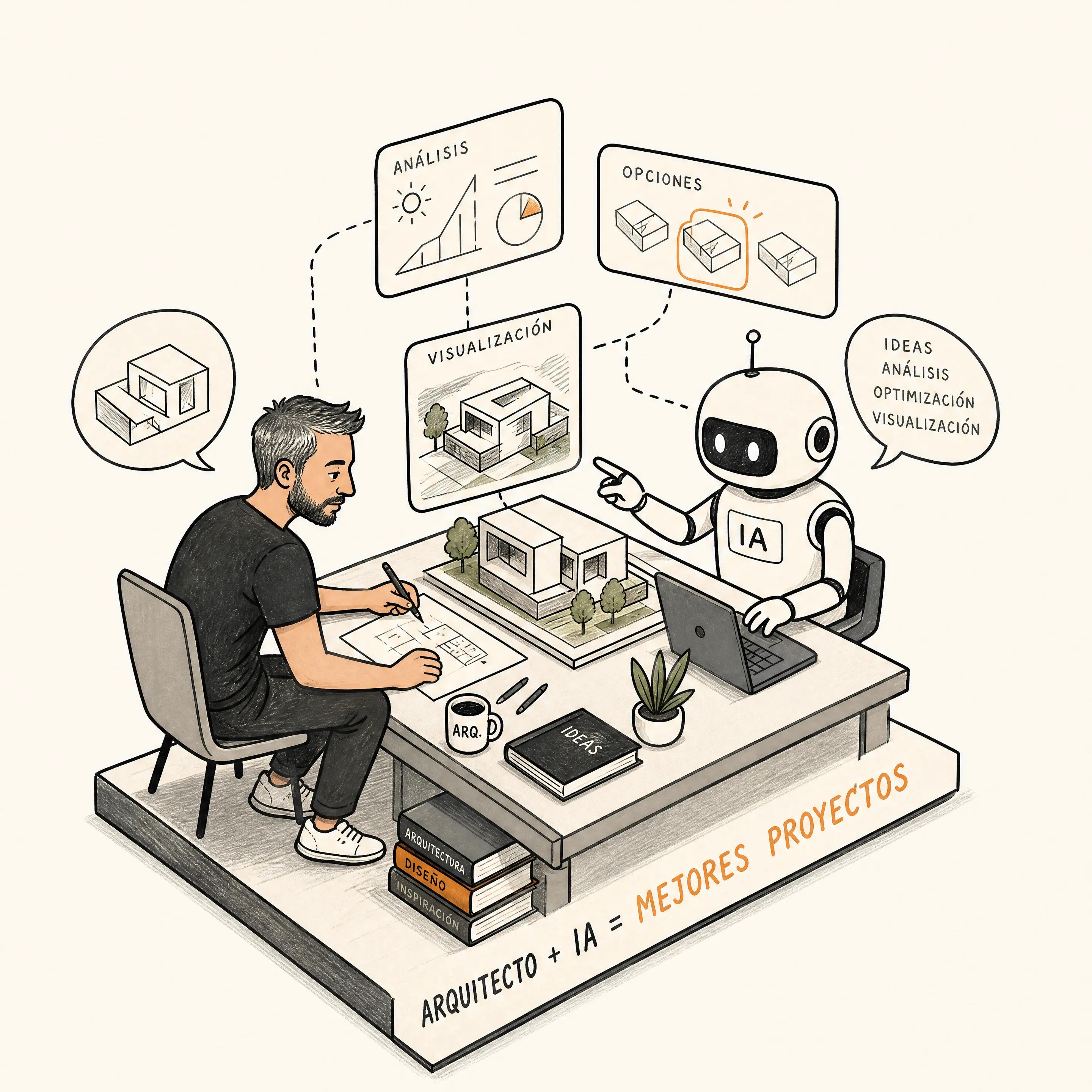
The right frame: amplification, not automation
The AIA itself coined the phrase in one of its most-read reports last year: **"Amplification, not automation"**⁵. The idea is simple and hard to internalize for anyone who has only read headlines: AI is not replacing architects, it is amplifying what one architect can do in the same amount of time.
Three data points from the same report help understand why this is the right frame:
- 84% of architects surveyed are optimistic about being able to automate manual tasks to save time¹.
- 74% see potential to support product research and specifications¹.
- But only 6% use AI regularly in their work and just 8% of firms have formally implemented it².
There is a huge gap between "I think it's useful" and "I'm using it." That gap is what we are crossing right now in small and mid-sized studios in Chile. It is not trivial to cross well.
What it changes at our studio
To get out of the manifesto plane, here's what actually changed at Moreno·Sosa over the last year. Honest, specific, and probably different in six months because the tools move fast.
Code review with a NotebookLM notebook. We built a notebook that ingests, in one place: the OGUC (Chilean building code), the local ordinance of the commune where the project sits, the active DDU bulletins from the Ministry, and their amendments. When a new project comes in, we cross-check the preliminary design against that body of regulation in a conversation, instead of re-reading hundreds of pages. It doesn't replace the final review an architect signs, but it quickly filters the points where the project could fail, before it advances too far. What used to take two or three days of cross-reading now takes a morning.
Iterating sketch, massing and materials with Magnific. This is where the change is most visible. We used to bring a client one proposal and two schemes. Today we start from a hand sketch, run it through Magnific to explore massings, test material palettes, adjust light. In one afternoon we can have six or seven honest versions of how the idea might look. The client doesn't decide by intuition on a single option: they decide between concrete, comparable alternatives, and tell us which one speaks to them. That conversation goes up in quality.
Serious modeling in Revit, side by side with AI. Once the direction is clear, the geometry is developed in Revit with architectural judgment, not with prompts. AI accompanies the process (answers questions, suggests alternatives, checks coherences), but we build the model ourselves, because that's where decisions are made that depend on understanding the whole: material junctions, real dimensions, MEP, code. That part stays deeply human.
Post-production with Nano Banana and AI video. Final images and project videos go through an AI layer: Nano Banana to generate and refine images with fine control over realism, and the latest video models for the animations we deliver. Texture, light and weather get adjusted with a precision that used to take days of manual work.
What working this way feels like, day to day
Short version: AI is one more worker on the team, who gives a frank opinion but doesn't decide. The final call is always the architect's. Every AI suggestion passes through a judgment filter: does this serve this client, in this place, with this budget, for this way of living?
A practical note we learned along the way: you have to configure it to be honest. By default, the models tend to be optimistic — they agree with you, validate the path, tell you the idea is brilliant. With explicit instructions to critique, push back and surface weaknesses, it becomes much more useful. It works better as a critical partner than as a cheerleader.
What changed for the client
This is the most important part, and the one missing from the global reports. Clients value that we use AI, because it multiplies the iterations between what we send them and what they review. Before, a façade decision could take two meetings with two weeks in between to prepare alternatives. Today we can bring six variants to the first meeting, adjust in real time as they react, and send the refined version with materiality and light defined the next day. For them, the project moves visibly faster without losing depth. For us, the hours saved in preparation get redirected to listening better.
None of this replaces the architect. All of this lets us spend more time on the space, the place and the client, which is what should never have been lost.
What AI is NOT doing (and probably won't anytime soon)
This is the part missing from the headlines. Clarity here is what separates the studio that adopts the tool from the studio that lets the tool use it.
It doesn't understand the place. AI can read 10,000 images of Tunquen, but it doesn't know that there, in February at 5 PM, the wind turns and slips into the ravine. The neighbors know. The local builder knows. The architect who stood on the site three times knows.
It doesn't know the client. A language model can summarize a brief, but it didn't hear the couple contradict each other about the dining room, didn't see who went quiet when budget came up. The most important decisions in a project come from what people don't say.
It doesn't take ownership on site. When a worker finds an unexpected root in the foundation, when winter arrives early, when the window supplier calls at 7 PM to say there's a two-week delay, someone has to make a quick decision with real economic consequences. That is not automatable. That is done by a human who understands the whole project.
It doesn't sign. In Chile, the architect signs the project and the sponsorship. Professional and civil liability is non-delegable. AI has no national ID, no Architects' Association membership, no insurance. Until that changes — and it won't soon — the architect remains responsible.
The right question
The question is not if AI will replace the architect. The question is what kind of architect will still be necessary, and there the answer is interesting.
The architect whose trade is producing plans fast, replicating typologies, processing permits and delivering a PDF on time, is in trouble. That part of the trade is being standardized and automated quickly, and competes against tools that cost USD 20 a month.
The architect whose trade is listening to the client, reading the place, proposing an idea with judgment, defending it, adjusting it, and taking ownership on site, not only isn't at risk: is probably more valuable than before, because their time is freed from repetitive tasks for what matters.
That is the architect we want to be, and that is why we adopt AI with enthusiasm, without fear and without the naïveté of thinking it is magic. It is a tool. A powerful one, but a tool.
What the good clients ask
We've noticed one thing over the last six months. Clients who end up doing a project with us almost never ask whether AI will replace the architect. They ask other things. They ask how many houses we've built in their area. They ask if we'll be on site. They ask how we work with limited budgets. They ask what happens when surprises come up.
Those are the right questions. They are human questions about trust, judgment and commitment. None of that is delegated to an algorithm. None of it.
Thinking about building your house and want to talk to architects who use AI without letting it replace them? Email contacto@morenososa.com or message Pablo on WhatsApp +56 9 6651 6033. We visit the site, listen to the program, tell you honestly whether we can or can't, and give you realistic ranges of time and cost.
Free download: "12 decisions that change your house on a plot" — our guide to what we usually cover in a first meeting, in coffee-read format. Ask for it on our contact page.